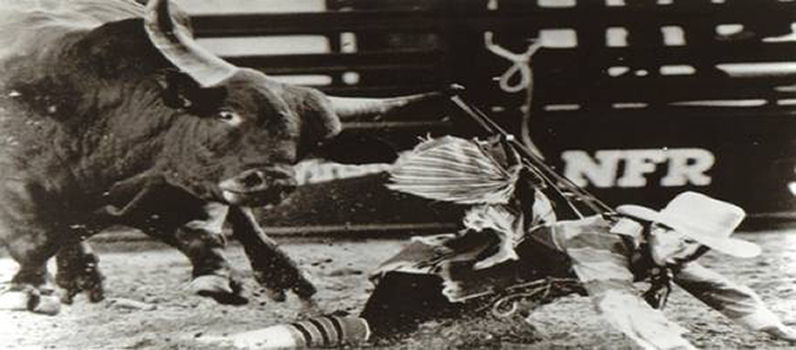
Each clown has his own style of fighting the bulls. Leon Coffee, veteran
clown explains, “Some guys have a lot of what you call bull savvy. I didn’t have
a lot of it, or experience, so I made up for it with speed. When the feets said
go, I was gone!” ‘Kamikaze’ Rob Smets has been called crazy by some of his fans,
because he will try anything. “My style has been kind of reckless abandon. If a
bull is jumpable, I’ll try it. It’s a thrill!”
But it’s not only bullfighting and rescuing cowboys that these greasepaint
matadors are known for. Audiences are also entertained by the clown’s
wise-cracking jokes and stunts. Cowboy clowns can turn any situation into humor
and are willing to try anything at least once. From sheepdog-riding monkeys to
water and popcorn fights, bucking car acts, and clown mobiles, these
entertainers keep audiences on the edges of their seats.
The book is written from the perspective of one who knows the back stage of
rodeo firsthand. Jeanne Joy Hartnagle-Taylor has been around the sport all of
her life. She used to exhibit trained stockdogs at many stock shows and rodeos,
including Denver’s famed National Western Stock Show and Rodeo.
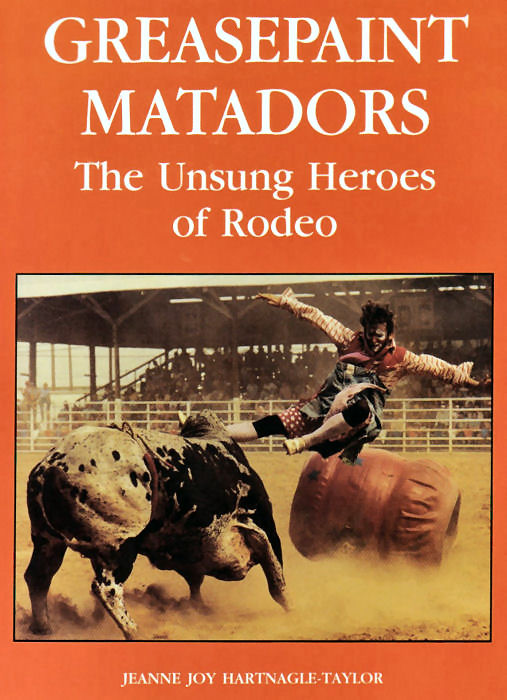
This timeless coffee table book features 176 pages of exciting, fun-filled,
humorous, and serious stories with more than 200 action packed photos to
compliment the lively narratives with some of rodeo’s greatest clowns and
bullfighters (the founding fathers of the sport). The first edition of
Greasepaint Matadors, the Unsung Heroes of Rodeo by Jeanne Joy Hartnagle-Taylor
is no longer in print. It is a must-have book for anybody with even the
slightest interest in rodeo. By special arrangement we are able to offer a
limited supply of books available from the first printing. The author has
autographed and numbered individual book plates for each book which will
increase the value of this collector’s edition.
© 1993 Jeanne Joy Hartnagle-Taylor
Book Reviews and
Readers’ Comments
Here is what readers are saying about
Greasepaint Matadors:
Rocky Mountain News
Author Jeanne Joy
Hartnagle-Taylor has written a “superbly researched picture book saluting
the rodeo clown.”
Midwest Book Review - Reviewer’s
Choice:
No one in the rodeo arena is more
valuable than the clowns who manage to thrill the crowd by darting around an
angry bull, or entertaining spectators with their hilariously crazy antics.
But its’ not just for fun. Many a bull rider owes life and limb to the
clowns who divert the angry bull’s attention long enough for the rider to
move clear of harm’s way. The story of these goofy gladiators of the rodeo
circuit is told for the first time in a great new book, Greasepaint
Matadors: The Unsung Heroes of Rodeo. Watching a man pitted against the
ferocity of bulls like the “Ice Man” and “Crooked Nose” takes your breath
away and sends a chill down your spine. The combined courage and seemingly
total disregard for their own welfare becomes apparent as these unique
individuals come to life on the pages of Greasepaint Matadors includes
statistics on clown of the year award, National Finals clowns, and much,
much more.
Jeanne Joy Hartnagle-Taylor has
written for numerous publications including The Western Horseman, The
Cattleman, and National Stock Dog Magazine. In 19845, she was nominated Dog
Writer of the Year for her book, All About Aussies (Alpine Publications). –
James A. Cox, Editor-In-Chief
Midwest Book Review (Oregon, WI),
Volume 12, Number 12 - December 05, 2002:
Greasepaint Matadors by Jeanne
Joy Hartnagle - Provides Extensive Interviews with Many Great Rodeo Clowns:
Enthusiasts of rodeo won't want to miss Greasepaint Matadors: The Unsung
Heroes Of Rodeo, a guide to the rodeo clowns who put themselves against huge
bulls to protect their riders from inquiry. They aren't the show-stoppers
but often they are the most important in rodeo bullfighting, and this
provides extensive interviews with many great rodeo clowns who have decades
of experience in the business. Black and white photos pack the account and
compliment some lively narratives.
Western Horseman Magazine, January
1993:
Greasepaint Matadors: The Unsung
Heroes of Rodeo - “If you combine the legs of Jim Brown, the bovine savvy of
a Spanish matador, and the wit of Jack Benny, then add a double dose of
intestinal fortitude and roll it up into a pair of baggy Wranglers,
greasepaint, and a western hat, when it all comes together you get that
incomparable individual, the rodeo clown,” says Dr. Lynn Phillips, rodeo
announcer.
And Hartnagle-Taylor writes about
it all. The rodeo clown’s roots are in the Wild West shows and circuses of
the late 1800s, and the author traces the development of this profession to
the present. She explores different aspects of the job: how individual
clowns got started in the business, how each applies his signature makeup,
how the announcer can make or break the clown’s act, why the barrel men
designed new and better equipment, and how the clowns evaluate the bulls.
These are the nuts and bolts of the rodeo clown’s profession.
But, there’s more.
Hartnagle-Taylor shares the heart and soul of the rodeo clown. Comments from
more than 20 professionals allow the reader to see through the greasepaint
to the person.
“I believe God put me in this
world to do two things. One is to make people happy; the other is to help
people out. I can do both out there in the arena.” - Leon Coffee.
“I’d much rather pull one bull
off a cowboy than jump five bulls in a row,” - Miles Hare.
Sometimes it’s a joy ride, and I
have time to clown around. Other times, it’s all I can do to maintain my
composure and senses,” - Tom Feller.
“If you’re being aggressive,
doing our job…you’re going to have wrecks,” - David Burnham.
“I don’t like to think about the
injuries; I like to think about the getaways,” - Deacon Jones.
“It’s your living, and you’ve
made a commitment,” - Skipper Voss.
These comments, and more, along
with 200 terrific action photographs are the essence of Greasepaint
Matadors. Hartnagle-Taylor became fascinated with rodeo clowns after
attending one of Rick Chatman’s clown schools 10 years ago. The fascination
held. She’s compiled a readable book with outstanding photography and paid
homage to an American tradition. – FS, Western Horseman Magazine, January
1993
The Brayer, Mules and More:
What does a book about rodeo
clowns have to do with mules and donkeys? This book (Greasepaint Matadors:
The Unsung Heroes of Rodeo) besides having great action pictures of nervy
clowns dodging the ferocity of those two ton bulls and clowning around for
the spectator’s delight, has the greatest photos of the rodeo clown’s
preferred sidekick – THE MULE AND DONKEY, Present day and historical photos
not only document the clown’s bravery in protecting the bull riding cowboys
with their own bull distracting antics, but they also chronicle the
entertaining partnership of the rodeo clowns and their long eared
companions. From chariot races, Roman riding, and comedy skits to the
delightful pictures of Jazbo Fulkerson and his twenty year companion a mule
named Eko visiting sick children in the hospital, we see the mules and
donkeys taking a place in some of the most famous photos from the National
Cowboy Hall of Fame and the Pro Rodeo Hall of Champions. This is a great
record of the unsung heroes of the rodeo and the unsung long eared
companions who have over the years brought many smiles to the faces of the
spectators. The book is the highest quality on slick paper with some of the
best action photos available. - Sue King, Owner/Publisher of The Saddle Mule
News
Rodeo News, May 1993:
Greasepaint Matadors: the Unsung
Heroes of Rodeo - This coffee-table style book captures rodeo clowns—their
history, their makeup, their skills, their comedy, and their lives.
Featuring more than 200 photographs and 16 pages of full color, this book is
as much fun to look at as it is to read.
Hartnagle-Taylor has done quite a
bit of research and has a true understanding and admiration of her subject.
Chapters focus on the history of rodeo clowns, cowboy humor, comedy acts,
injuries, why they choose this life, barrel clowns, cowboy protection, the
bulls, what is bullfighting, makeup, how they got started and what it takes
to become a rodeo clown.
The book personal commentaries
from more than 20 rodeo clowns in its 200 plus pages and dozens of other
glimpses into the life of a rodeo clown. Also featured in the book are
comments from quite a few rodeo announcers who relate stories about many of
the clowns they have worked with.
– Johna Cravens
Rodeo Clowns finally get their due
in “Matadors” - The Rocky Mountain News, February 4, 1993:
Send in the clowns...you’ve got
to have clowns…” That’s never so true as in the nerve-wracking world of the
rodeo bull rider.
In the noise and the dust and the
heart-stopping confusion, when an enraged 2,000 pound Brahma bull throws the
rider and turns to demolish the pest who has been sticking on his back, it’s
the rodeo clown who runs to the cowboy’s rescue.
If the bull rider is the
aristocrat of the rodeo, then surely the rodeo clown must be acclaimed for
his superb athletic ability. The clown must pit his mind and body against a
thunderbolt of fury, the very angry and frustrated bull.
Jeanne Joy Hartnagle-Taylor 38,
has written a superbly researched picture book saluting the rodeo clown,
Greasepaint Matadors: The Unsung Heroes of Rodeo.
Featured in Hartnagle-Taylor’s
book are clowns Rick Chatman and Leon Coffee, two artists at their dangerous
trade who helped the author research her book.
A native Coloradan,
Hartnagle-Taylor and her five brothers and sisters work with their parents
in a 40-year-old dog-training operation on a ranch outside Boulder, They
specialize in training Australian shepherds and Border collies as working
dogs and as trick performers for circuses, rodeos and other professional
appearances.
Dog training is what drew
Hartnagle-Taylor into the world of rodeo clowning. “Ten years ago, my sister
trained a dog for a rodeo clown."
“She describes the clowns as
obsessed by “ecstasy that comes from overcoming danger.” In her book, she
spins a story about Skipper Voss, the 1982 wrangler bullfighting
champion-turned-clown who survived eight knee surgeries. “He said, ‘If a
cowboy got his leg tore completely off, he’d pick it up and carry it back to
the doctor and ask, “Can you get me going for the next week, Doc? Instead of
asking, “Will I ever walk again? “
There’s no doubt that rodeo
clowning is supremely dangerous, but “most rodeo clowns started out as bull
riders, so they realize the danger and understand how to handle the bulls,”
Hartnagle-Taylor explains.
But in fact, while the clowns can
whip the crowd to laughter, that laughter can turn a stunned silence and
groans when a bull rider’s life in danger and the clown himself skirts close
to disaster. Hartnagle-Taylor includes the history of rodeo clowning, which
resulted from combining the arts of circus and rodeo in Buffalo Bill’s Wild
West Show in the 1880s. The earliest photograph is dated 1919 and shows “Tin
Horn” Hank Keenan, complete with polka-dot shirt, beat-up one-gallon hat and
spurs.
The book is loaded with marvelous
photographs, some in color, and many provide a vicarious thrill. A clown
dancing inches in front of a charging bull may seem funny, but what if the
bull doesn’t want to waltz?
Hartnagle-Taylor’s book provides
all anyone would want to know about the world of rodeo clowns — history,
training, humor, costumes, makeup, bull personalities, even payday for the
clowns.
These greasepaint matadors earn
from $350 to $500 a performance. If this sounds like a handsome fee, imagine
yourself ye to red eye with a bull in a bad mood, and think again. –
Margaret Carlin
Loveland Daily Reporter-Herald,
December 26-27, 1992:
Jeanne Joy Hartnagle’Taylor’s
book about rodeo clowns, “Greasepaint Matadors: The Unsung Heroes of Rodeo,”
is very colorful, packed with photographs (some historic) and brings with it
a sense of summer heat, arena dust and rip-roaring action — not a bad
feeling on a winter night. The large format book is published by Alpine
Publications, Inc. of Loveland.
Hartnagle-Taylor is from Boulder.
She comes from a pioneer Colorado ranching family and is a nationally-noted
handler working with stock dogs.
She has written on stockdogs for
a number of publications and was named Dog Writer of the Year in 1985 for
her book “All About Aussies,” also published by Alpine.
Hartnagle-Taylor just returned
from a three-month road trip hitting major rodeos from Texas and New Mexico
to Winnipeg, Manitoba, Canada. She presented her shows called Wonderful
world of Dogs and Super dogs. They feature Australian Shepherds and Border
collies she has trained.
Also on tour was her husband,
musician Ty Taylor, and his Powder River Band. In an interview,
Hartnagle-Taylor said her journey into an examination of an unsung facet of
rodeo came not only from spending her life around horses, from watching her
brother and sister who did bareback bronc riding and barrel racing
respectively. She has spent a lot of time in rodeo arenas.
In recent years, Hartnagle-Taylor
trained some trick dogs for cowboys who had chosen the life of a rodeo
clowns.
When she decided to do research
pointing toward a book on rodeo clowns, she discovered that there wasn’t
another book on the “greasepaint matadors” out there.
She embarked on the trail of the
seemingly fearless bullfighters and received what she calls “a college
education in the subject.”
She watched them work and heard
the multitude of stories that follow them in the wild and wooly trade they
ply, entertaining the crowd and saving bull riders from injury.
Hartnagle-Taylor put it all into
the book with an unadorned, almost conversational writing style.
“It took me a couple of years to
fully appreciate and understand what they do, to really get acquainted with
the people,” she said. She even attended a bullfighting school to get more
of a feel for the action.
Hartnagle-Taylor said there is
not one “type” of cowboy who becomes a rodeo clown.
“But I think anybody involved in
a dangerous sport has a certain disregard for danger; and for rodeo clowns,
a greater tolerance for pain,” she declared.
The staggering array of injuries
lurking beyond the laughter generated by the clowns is discussed in the
chapter called Stretching the Limits. Some amazing photographs bring home
the danger inherent to the bull riders and their clown protectors.
From the multitude of stories
about the clowns, many of them humorous, that go the rounds of rode,
Hartnagle-Taylor picked primarily the ones that had a common thread. Some of
have become legends of the sport.
“These men become larger than
life,” she said decidedly. Pressed to name a favorite, one who seems to
epitomize the aura of the rodeo clown, Hartnagle-Taylor chooses Leon Coffee,
1983 Clown of the year: “No matter how much he hurts, in the arena, you
never know.”
“Greasepaint Matadors: The Unsung
Heroes” moves through the history of bullfighters from the “caping” of Texas
vaqueros before the Civil War protecting bull riders to the introduction of
“character” clowns and greasepaint makeup, and into the mechanized tricks or
gags of some of today’s rodeo clowns.
Nobody in rodeo makes the kind of
money that professional athletes make in many other high-profiles sports,
but, besides that, rodeo clowns remain virtually anonymous behind their
greasepaint, according to Hartnagle-Taylor.
Why do they do it?
Pride, according to Wiley McCray,
who says, “I’ve got a ranch at home and I could make a living there, but
anyone can be a farmer; not everyone can be a rodeo clown.”
And for the thrill, as Rick
Chatman, 1984 Wrangler Bullfighting Champion says, “I fight bulls for the
rush that comes from within. It is exciting, and the average guy won’t do
it. It is an accomplishment to handle an animal that is 10 times your weight
and outmaneuver him because of your athletic ability.”
Phyllis Walbye, Reporter
Greasepaint Matadors — they live
on the edge, and in the center of an arena that becomes as dangerous as a
bullring in Spain.
Rob Smets, 5-time World Champion
Bullfighter, the Kamakazee Kid, 2010
This is a great book!
New book highlights colorful world
of rodeo clowns – Super Looper Magazine, December 1992:
In rodeo parlance, “clowning” has
come to mean bullfighting as much as zany behavior, and the terms “cowboy
clown,” rodeo clown,” and “bullfighter” are often used interchangeably.
No one in the rodeo arena is more valuable than the clowns who manage to
thrill the crowd by darting around an angry bull, or entertaining spectators
with their hilariously crazy antics. But it’s not just for fun. Many a bull
rider owes his life and limb to the clowns who divert the angry bull’s
attention long enough for the rider to move clear of harm’s way.
The story of these goofy gladiators of the rodeo circuit is told for the
first time in a new book, Greasepaint Matadors, the Unsung Heroes of Rodeo,
published by Alpine Publications, Loveland, Colorado.
Watching the man pitted against the ferocity of bulls like the “Ice Man” and
“Crooked Nose” takes your breath away and sends a chill down your spine,
says author Jeanne Joy Hartnagle Taylor. The combined courage and seemingly
total disregard for their own welfare becomes apparent as these unique
individuals come to life on the pages of this new book. Comments by over 20
professional rodeo bullfighters and a dramatic array of photos, many in
stunning color, makes the exciting, bizarre, frequently dangerous world of
rodeo clowns come to life. Includes statics on clown of the year award,
National Finals clowns, and much more.
Behind the Scenes - December 05,
2000, Chad Rogers (Sioux City, IA):
Wow! Having met several of the
subjects of this book has given me a unique opportunity. This book shares
the countless road stories and "founding fathers" of the sport. From the
pain and anguish of being run over by a 2,000 pound animal to the joy of
entertaining a crowd of thousands, it's all part of the life. A must-have
coffee table book for anybody with even the smallest interest in
professional rodeo. Excellent photos!!
Mike Spencer, Retired Rodeo Clown
and Bullfighter (Bakersfield, CA), 2010
Jeanne did a great job putting
this book together, she's a real hero to the clowns and bullfighter.
Return to the Stewardship and Education page

HARTNAGLE’S LAS ROCOSA AUSSIES
E-mail:
lasrocosaaussies@aol.com
Telephone: 303.659.6597
Fax: 303.659.6552
Breeding Sound Versatile Aussies Since 1955
Founding/Lifetime Members ASCA and USASA
Copyright© 1999-2015. All
information, pictures & graphics contained on this website belong to
Las Rocosa Australian Shepherds & cannot be reproduced without
written consent. All Rights Reserved.
The Hartnagle's Las Rocosa
website designed & maintained by
Mikatura Web Design
|